Holiday Exercise Ideas: 10 Realistic Ways to Stay Active When Your Schedule Is Packed
Between Thanksgiving and New Year’s, I do not expect most people to follow a perfect workout plan. In our Indiana, Pennsylvania office, I hear the same honest version of the season every year: school events multiply, work deadlines tighten, travel changes routines, daylight disappears early, and western Pennsylvania weather can make a simple walk feel like a major production.
That does not mean movement has to disappear. In my experience, the most sustainable holiday approach is to set a minimum activity baseline: a small amount of movement you can keep even on the busiest days. It is not a punishment for holiday meals, and it is not an all-or-nothing fitness challenge. It is a practical way to keep your body familiar with moving.
As a chiropractor who has served Indiana County patients since 2002, I have seen how quickly people can lose momentum when they believe a missed gym session means the whole week is ruined. I would rather see you take a short walk, complete a few comfortable strength movements, or turn family time into active time than wait for a “normal” schedule that may not arrive until January.
Start With a Holiday Baseline, Not an Unrealistic Streak
Before choosing activities, decide what “enough” looks like for this particular season. Your baseline might be a brief daily walk, several movement breaks during the workday, or a short strength session a few times each week. The right baseline is one you can complete when your calendar is crowded—not only when life is quiet.
I encourage patients to think in three simple categories:
- Daily mobility: gentle, comfortable movement that helps you avoid being in one position all day.
- Weekly strength: basic body-weight or resistance exercises that fit your current ability.
- Family and social movement: active traditions that make movement part of the gathering rather than another appointment to schedule.
If you do more on a free day, excellent. But your baseline protects you from the “I have no time, so I will do nothing” trap. As a 100 Year Lifestyle Certified practitioner, I view this as a long-term approach: the goal is to build a body and routine that support the life you want to keep living, including during its busiest weeks.
10 Realistic Ways to Stay Active During the Holidays
1. Put a short walk on the calendar before the day gets away from you
Choose one reliable window: before the household wakes up, at lunch, after work, or after dinner. A walk does not have to be long to count. The key is reducing the number of decisions you need to make. Put on warm layers, choose supportive footwear, and use a familiar, well-lit route when conditions allow.
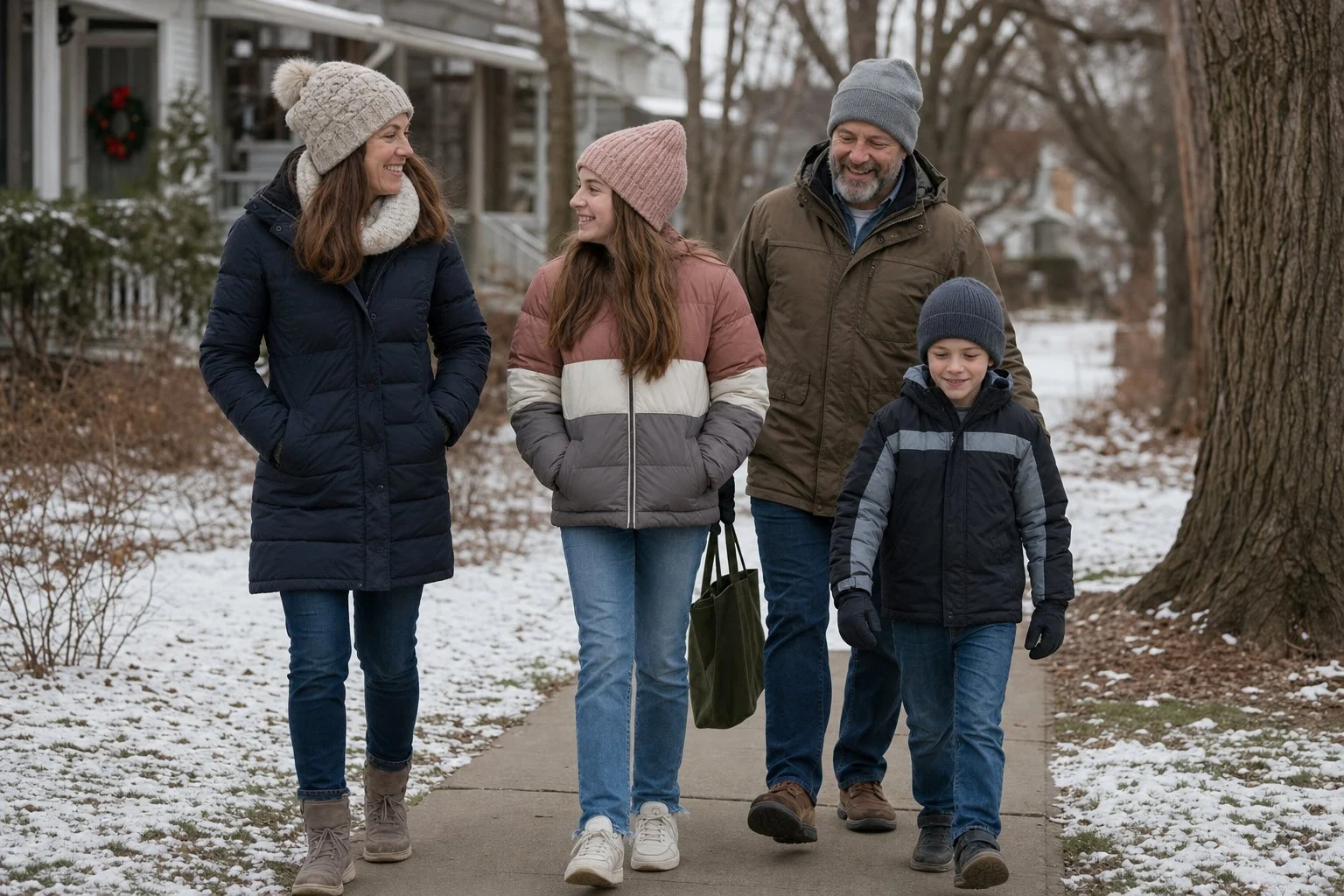
For a family, a post-dinner loop can become a simple tradition. For someone working from home, a short walk before opening the laptop can create a useful transition into the day. If ice, heavy rain, or early darkness makes outdoor walking feel unsafe, use one of the indoor options below instead.
2. Use the “one song” movement break
One of my favorite strategies for people who feel they have no extra time is to move for the length of one song. Stand up, march comfortably in place, step side to side, walk the hallway, or do a few gentle sit-to-stands from a sturdy chair. Repeat once or twice later if you can.
This is particularly helpful during holiday baking, online shopping, movie watching, and long stretches of desk work. It also breaks up the stiffness that can build when you stay seated or hunched over a phone for hours.
3. Keep a no-equipment strength circuit ready
A short strength routine at home removes commuting time and weather as barriers. Choose movements that feel controlled and comfortable for your body, such as sit-to-stands, wall push-ups, standing calf raises, gentle countertop-supported hip hinges, or step-ups on a stable low step.
Try a simple circuit: perform one comfortable set of each movement, rest as needed, then repeat if you have time. Quality matters more than speed. Stop if a movement produces sharp, spreading, or worsening pain, dizziness, weakness, or other concerning symptoms. If you are returning after a break, begin with fewer repetitions than you think you need and build gradually.
4. Make holiday errands less sedentary
Errands are not a replacement for intentional exercise, but they can be an opportunity to add movement. Park farther away when it is safe, take an extra lap through the store before checking out, or carry manageable bags with balanced loads rather than overloading one shoulder.
I am especially cautious about the “one-trip” approach to heavy packages, decorations, or grocery bags. Rushing, twisting, and lifting awkwardly are common ways people aggravate a sore back. Make two trips. Keep items close to your body. Turn your feet instead of twisting through your trunk while carrying a load.
5. Turn family gatherings into active traditions
Holiday activity works better when it feels like connection rather than an obligation. Consider a neighborhood walk before dessert, a casual game in the yard, a scavenger hunt for children, dancing while dinner is prepared, or a friendly indoor movement challenge between football quarters.
The point is not to make every relative exercise. Offer a low-pressure invitation and make participation easy. Some family members may prefer walking, while others may enjoy helping set up an activity or simply joining for a few minutes. A tradition that people look forward to is more likely to last than a complicated workout plan.
6. Create an indoor weather backup plan
Indiana County winters demand flexibility. When sidewalks are slick or the weather is unpleasant, have a plan that does not require driving to a gym. Walk laps in your home, use stairs if they are safe for you, follow a beginner-friendly movement video, or visit an indoor public space where walking is permitted.
You can also build a simple “commercial break plan”: during each break, stand, walk around the room, or perform a few controlled chair stands. The goal is to interrupt prolonged sitting. If you have a balance concern, choose stable surfaces, keep pathways clear, and have a counter or sturdy chair nearby for support.
7. Make travel days movement days
Long drives and extended sitting can leave your neck, back, and hips feeling tight. When you travel, plan for regular stops when practical. Walk briefly, gently move your shoulders and hips, and reset your posture before getting back in the car. Avoid sitting on a wallet or other bulky item in a back pocket, which can create an uneven position.
For more practical guidance on arranging your seat, managing bags, and avoiding the common travel posture mistakes I see in our office, read our travel-posture guide. A few small adjustments can make the trip more comfortable without turning travel into a complicated project.
8. Schedule movement before holiday events, not after them
Waiting until the end of a long party or late dinner to exercise often means it will not happen. Instead, use the hour before an event for a walk, a few strength movements, or a mobility routine. It creates a clear appointment with yourself before the day becomes unpredictable.
This approach also avoids the unhelpful idea that exercise must “earn” food. Movement is valuable because it supports your routine, energy, strength, and ability to participate in daily life. It is not a debt payment for enjoying a holiday meal.
9. Choose “comfortably challenging,” not punishing
The holidays are not the ideal time to suddenly begin an intense routine that leaves you overly sore or exhausted. If you have been inactive, use a pace that allows you to recover and return to movement again. If you already exercise regularly, you may choose shorter versions of your usual routine instead of abandoning it altogether.
I often remind patients that consistency is not the same as intensity. A modest routine repeated through a busy month can be more useful than one ambitious workout followed by several days of discomfort and avoidance.
10. Protect the first week after a missed routine
Missed workouts happen. Travel, illness, family responsibilities, and weather can all interrupt a plan. What matters is your next reasonable step. Do not try to make up every missed session in one weekend. Return with walking, gentle mobility, or a scaled-down strength session, then increase based on how your body responds.
If pain, fear of movement, or uncertainty is what keeps stopping you, that is worth discussing with a licensed health professional. Our return-to-exercise article offers a helpful starting point for easing back into activity after time away.
How to Modify Movement for Back, Neck, or Joint Discomfort
At Sleppy Chiropractic, I see people who want to remain active but are understandably cautious because of back pain, neck discomfort, knee irritation, or a prior injury. The answer is not always “push through,” and it is not always “stop everything.” Often, the better question is: What type and amount of movement can I do comfortably today?
- For back discomfort: Favor short walks, supported sit-to-stands, and controlled movements over repeated bending, twisting, or heavy lifting. Break longer tasks into smaller pieces.
- For neck discomfort: Avoid spending long periods looking down at a phone while shopping, traveling, or sitting on the couch. Bring screens closer to eye level and take frequent posture breaks.
- For knee, hip, or foot discomfort: Choose flatter routes, supportive shoes, and lower-impact options such as indoor walking or seated-to-standing strength work. Reduce range of motion if deeper bending is uncomfortable.
- For balance concerns: Move near a stable support, clear tripping hazards, and prioritize controlled, predictable exercises rather than rushing.
New or severe pain, pain after a fall, numbness, progressive weakness, loss of coordination, or symptoms that concern you deserve prompt medical evaluation. Exercise guidance should be individualized, particularly if you have a diagnosed condition, are recovering from surgery, or have been advised to limit activity.
What We Talk About With Patients at Sleppy Chiropractic
In our office, the conversation is rarely just, “What hurts?” We also ask what a person needs to do: carry groceries, get through a work shift, travel to see family, play on the floor with grandchildren, or return to an activity they enjoy. Those real-life details help us discuss a practical mobility plan.
My colleagues, Dr. Evan R. Ludwig, D.C., Dr. Seth Link, D.C., and I provide patient-centered chiropractic care with a non-surgical, drug-free focus. Depending on a patient’s history, examination, goals, and appropriateness for care, that conversation may include chiropractic care, movement guidance, and discussion of supportive options available in our office, including decompression therapy, shockwave therapy, MLS Laser Therapy, or PEMF Therapy. These services are not a substitute for a personal evaluation, and no single approach is right for every person.
After more than two decades in practice, I have learned that sustainable plans are built around real schedules. We want patients to ask questions, understand their options, and feel respected throughout care. Privacy matters in our office, so while I can share common patterns I see—like people feeling discouraged after a busy month—I will not turn a patient’s personal health experience into a holiday story.
Let Your Holiday Routine Be Small Enough to Keep
The strongest holiday movement plan may not look impressive on paper. It may be a bundled-up walk around the neighborhood, a few chair stands while the coffee brews, a lap through the house during a snowstorm, or an active family tradition that gets everyone off the couch for a little while.
I encourage you to choose one or two ideas from this list today and make them easy to repeat. Keep your baseline realistic. Adapt when your schedule or the weather changes. Then, when January arrives, you will not be starting from zero—you will be continuing a relationship with movement that stayed intact through the season.
If discomfort is making that feel out of reach, our team at Sleppy Chiropractic in Indiana, PA is here to talk through your concerns and help you explore appropriate next steps. You do not need a perfect holiday routine. You need a workable one.
About Dr. Matthew Sleppy
Founder, Sleppy Chiropractic
Dr. Matthew Sleppy is the founder of Sleppy Chiropractic in Indiana, PA, where he has been serving patients since 2002. A lifelong Indiana County resident, Dr. Sleppy attended Penns Manor High School and IUP before earning his Doctor of Chiropractic degree Magna Cum Laude from Life University. With over 20 years of experience and more than 10,000 patients helped, he specializes in neuromuscular and skeletal health, including post-concussion care through his advanced training in applied clinical neuroscience. Dr. Sleppy is a certified 100 Year Lifestyle practitioner, committed to helping patients build long-term vitality through proactive, evidence-based chiropractic care. When he’s not in the office, he lives on a horse farm in Creekside, PA with his wife Jennifer and their four children.
Disclaimer: The information provided on this website is for educational purposes only and is not a substitute for professional medical advice, diagnosis, or treatment. Please consult with a licensed healthcare provider for personalized care.